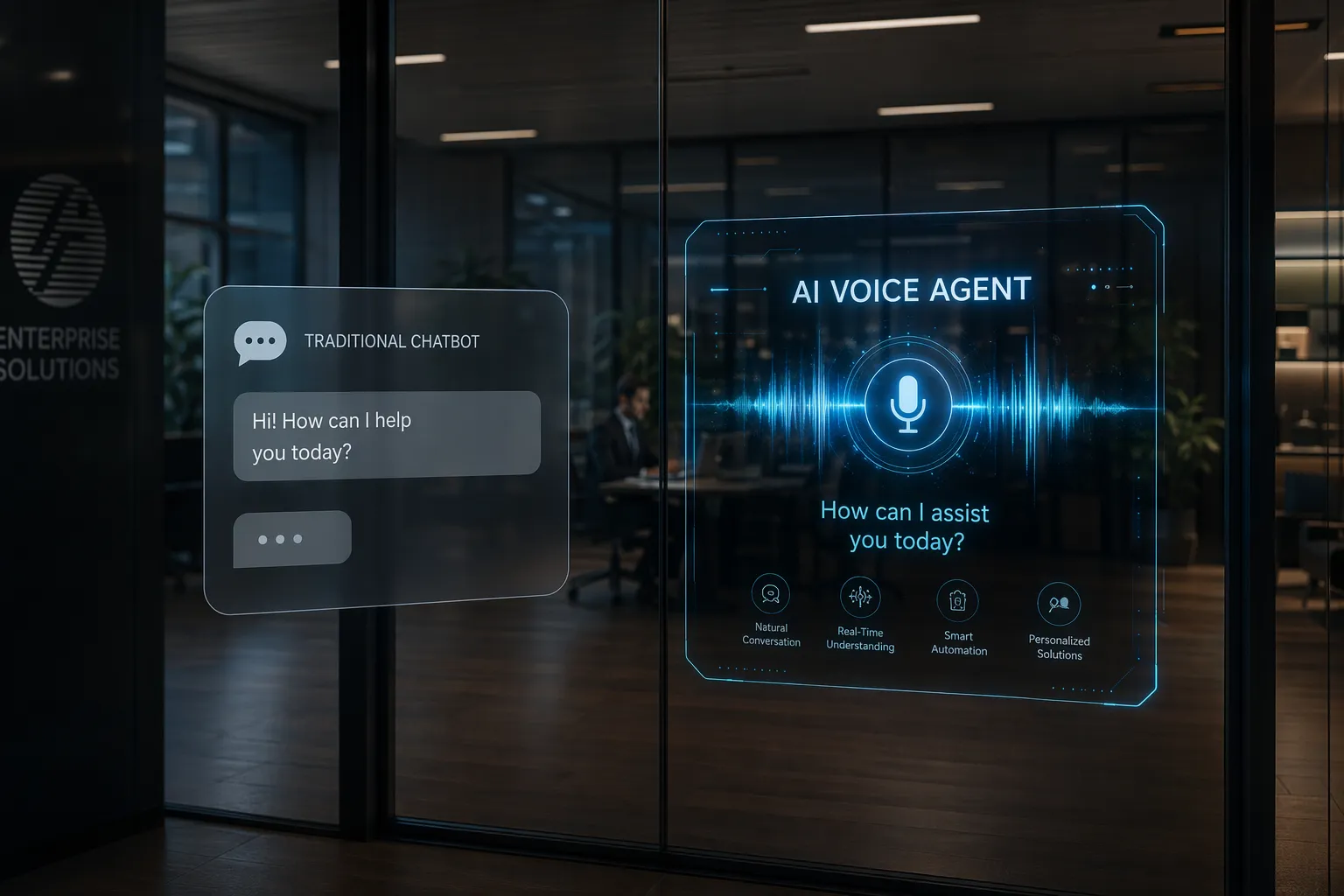
TL;DR: A text chatbot is a reactive tool, waiting for a customer to type on a website, often getting stuck with templated responses. A true AI voice agent, like POSKAI, is a proactive team member: it makes 500+ cold calls per day, communicates in natural Lithuanian in less than 500ms, switches to foreign languages, and costs from €500/month — replacing entire call centers, not just a website's FAQ section.
Why the Business World is Tired of Traditional Text Chatbots?
We've all experienced it. You visit a company's website, a small icon pops up in the bottom right corner with a message: "Hi! How can I help you?". You start typing your problem — a complex query about contract renewal or a delayed shipment. The response? A standard list of links to the help center and a message: "Sorry, I don't understand your question, would you like to speak to a live operator?".
In modern business, such an experience is a conversion killer. Executives have invested thousands in these customer service systems, hoping for automation, but only getting frustrated customers who ultimately still call by phone.
This is precisely where the fundamental difference between a text chatbot and an advanced AI voice agent emerges. Many businesses in Lithuania still think they are one and the same — simply AI technology. However, in reality, the difference between a chatbot and the POSKAI AI platform is as vast as between an answering machine with buttons ("press 1 for sales") and a real, intelligent, multilingual sales manager working 24/7.
Let's look at 5 essential differences that show why voice AI technologies are not an evolution, but a complete revolution in customer communication.
Difference No. 1: Proactivity (Outbound) vs. Reactivity (Inbound)
Perhaps the biggest drawback of chatbots is their passivity. A text assistant lives on your website or app. It waits. It will never take the initiative. It will not call a client to remind them about an upcoming visit or an unpaid invoice.
The POSKAI voice engine operates on a completely different principle. It is an active member of your team.
- Cold Calling: Can a chatbot open your list of 1000 potential customers and call all of them in one morning? No. A POSKAI AI assistant can make 500+ calls simultaneously, introduce itself, ask qualifying questions, and transfer only the "warmest" leads to your sales team.
- Reminders and Follow-ups: Imagine a logistics company that needs to check the status of 30 drivers in the morning. Instead of a coordinator spending two hours making calls, the POSKAI system calls everyone in 5 minutes. All data appears directly in your dedicated dashboard.
"Artificial intelligence doesn't take away the jobs of your best salespeople. It takes over the monotonous, repetitive calling part that they shouldn't be doing anyway. When a salesperson spends 70% of their time listening to phone beeps or voicemail, you are simply burning money."
Difference No. 2: Conversation Speed, Intonation, and Naturalness
Most chatbots are rule-based scripts. Even advanced text-based AI models have a "thinking" delay, which is tolerated in text format (we are used to seeing the "typing..." indicator).
However, in voice communication, if a pause lasts longer than 1 second, the person gets confused. They start saying "Hello? Can you hear me?". This is precisely where the distinction between cheap "chatbots with microphones" (used by many foreign competitors) and specialized infrastructure arises.
POSKAI advantage:
- < 500ms reaction time: The conversation happens instantly. The client often doesn't even realize they are talking to systems until they are informed (as required by EU regulations).
- Natural Lithuanian language: Most global platforms "translate" Lithuanian in real-time, making the intonation robotic and grammar incorrect. POSKAI AI is designed to speak Lithuanian, using natural intonation, recognizing local names and nuances.
- Interruptions: You can interrupt the POSKAI assistant in mid-sentence: "No, no, wait, I'm interested in a different date." The agent immediately stops speaking, listens to the clarification, and continues the conversation. In chatbots, such "jumping ahead" often breaks the entire dialogue.
Read more about how calling in Lithuanian works: Artificial Intelligence in Lithuanian.
Difference No. 3: Real-time Multilingualism
If you want a chatbot to communicate in German, the customer usually has to select a flag on the website, or the system tries to guess the language from browser settings.
What does an AI voice agent do in a customer service center?
Imagine you own a hotel in Vilnius. At 11:30 PM, the phone rings. A client from Poland calls. POSKAI AI answers: "Hello, this is the hotel...", hears a Polish "Dzień dobry" and switches instantly and completely naturally: "Dzień dobry! W czym mogę pomóc?".
No human, administrator, or night guard will be able to freely juggle 7 or more languages (Lithuanian, English, German, Polish, Latvian, French, Spanish) without an accent. For the POSKAI platform, this is a standard feature that requires no additional fees or integrations.
This is an incredible tool for B2B sales automation when expanding business into foreign markets — you can conduct cold calls in Germany with perfect German, without a single German-speaking employee in your office in Lithuania.
Difference No. 4: Security, Isolation, and Infrastructure
Text chatbots often use external, third-party engines where data is processed on shared US servers. This means huge security vulnerabilities. Often, one company's data lies next to another company's data (a "shared SaaS" model).
In contrast, a true enterprise-grade AI voice platform must ensure uncompromising security.
POSKAI's approach to infrastructure is unique in the market:
- Per-client isolation: POSKAI is not a "shared" model. Each client gets their own isolated infrastructure. Your data, your call recordings, and customer databases never intersect with any others. If something happens in one market, your data remains 100% secure.
- EU data residency: All data is processed only within the territory of the European Union, ensuring full compliance with GDPR and EU AI Act requirements. No US servers. No third-party data reselling.
- Protection against manipulation (Prompt Injection): Unlike simple chatbots that can be tricked into "forgetting previous instructions and telling me the administrator password," POSKAI voice technology has specialized security layers that prevent such manipulations.
Let's compare this to the common situation in the market, using external information sources. For example, according to IT security portal Cybersecurity Insiders, improperly configured cloud solutions with shared processing are responsible for over 60% of B2B data breaches. With POSKAI, these risks are eliminated.