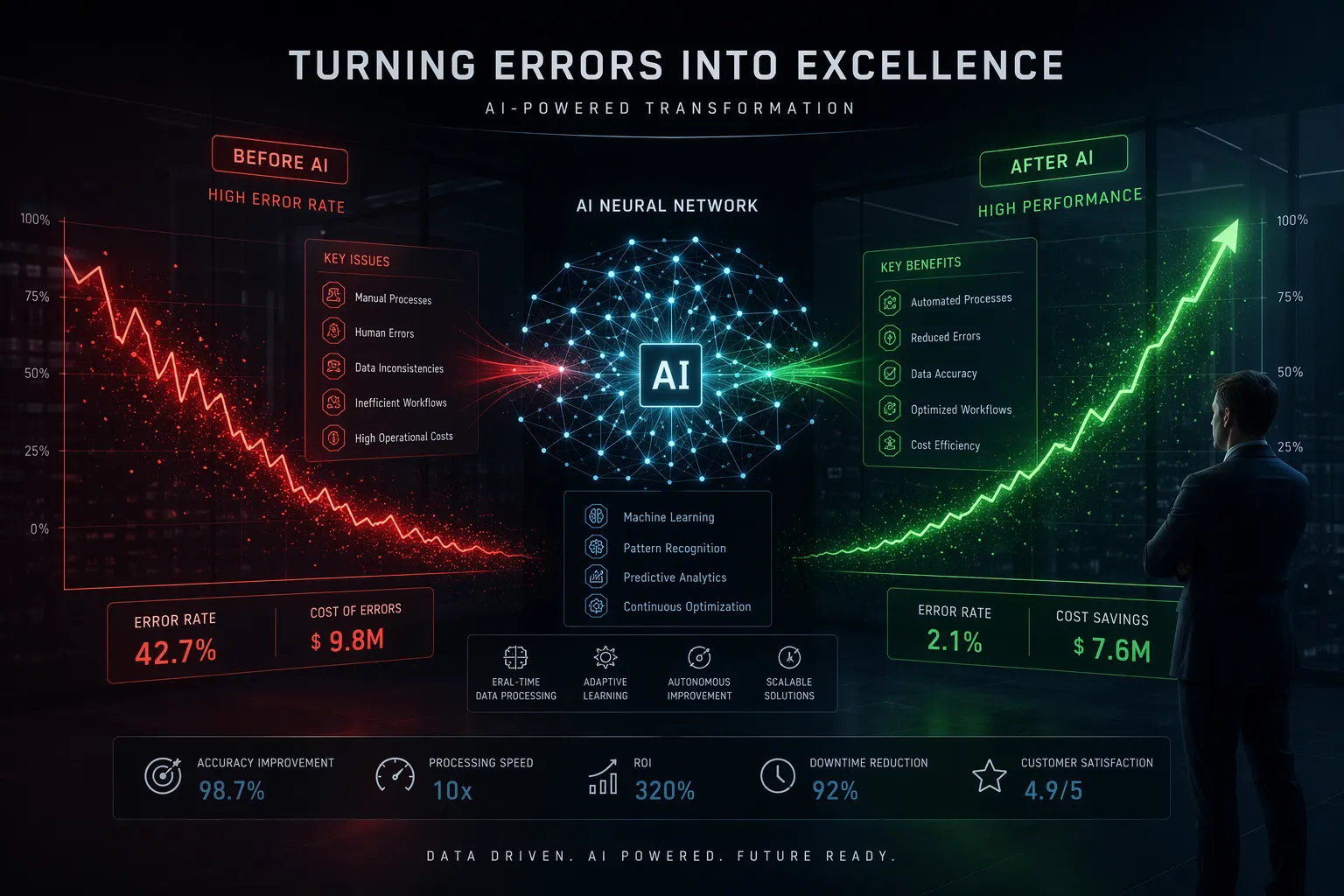
TL;DR: Up to 80% of artificial intelligence projects in business fail due to technical complexity, hidden fees, and non-compliance with GDPR requirements. POSKAI solves this problem by offering not a tool you have to program yourself, but a fully managed infrastructure. A call assistant, speaking natural Lithuanian and isolated according to the highest EU security standards, costs from €500/month — no hidden fees or long-term hassles.
Why Do Up to 80% of AI Initiatives Miss Their Mark?
In the business world, we constantly hear about the artificial intelligence revolution. Conferences are full of success stories, and consultants promise that AI will automate everything overnight. However, the reality faced by Lithuanian business leaders often looks completely different. Thousands of euros are invested in "custom" solutions, dozens of hours are spent on training, and the result is a system that does not work as promised, or requires even more maintenance than old processes.
Global statistics and research show that the majority (about 80%) of corporate AI initiatives get stuck in the experimental stage. Why does this happen? Is the technology still too early? Or perhaps the problem lies in how companies try to apply this technology?
Most often, companies face a fundamental factor in AI project failure: trying to become IT companies themselves. A transport company director does not have time to maintain servers, and a sales manager should not worry about updating voice models. It is for this reason that POSKAI emerged — we solve the technical challenges of AI implementation so that you can focus on your business.
Key Reasons Why AI Implementation Challenges Sink Businesses
1. Experimentation Without Clear Business Goals ("Doing It Because It's Trendy")
- Illusion: We will hire programmers to create a "custom bot" for us, and suddenly all processes will speed up.
- Reality: An expensive toy (for €5,000–€15,000) is created, which can only answer standard questions from the website. After six months, this solution becomes obsolete, the programmer disappears, and the system lacks support.
- Business Pain: The company wasted its budget on a solution that did not pay off, and employees continue to do everything manually. Successful AI implementation does not start with technology, but with a specific problem, for example: "We need to process 200 calls a day, 70% of which are the same questions."
2. The Illusion of Security and Disregard for Data Isolation (GDPR Risk)
One of the biggest sources of AI project failures is the disregard for GDPR and the new EU AI Act requirements.
Many cheaper or American AI platforms on the market operate on a "shared SaaS" (single umbrella) model. All clients, their clients' phone numbers, call recordings, and trade secrets lie in the same database. If one of the platform's 500 clients experiences a security breach, your client data is also at risk.
Furthermore, sending data through US servers automatically violates GDPR. Fines for such violations can reach up to €20 million or 4% of annual turnover, and legal responsibility always falls on you, not the technology provider.
3. Language Barrier: Not Adapted to the Lithuanian Market
The Lithuanian language is complex. It has cases, conjugations, specific syntax, and pronunciation.
When companies try to use standard, global tools and connect them to a "translate to Lithuanian" function, the result is tragic. A robotic, stuttering voice that cannot correctly pronounce the company name or customer's name. Such an AI assistant not only doesn't help but also harms your company's image. Customers hang up after the first three seconds.
4. Technical Obsolescence and Maintenance Costs
Artificial intelligence advances not in years, but in weeks. If you paid for a one-time solution development, it will be hopelessly outdated in three months. You will need new features, integrations, and speed optimization. Who will do this? The internal IT team, which is already overloaded? This leads to frustration and the eventual abandonment of the project.
"Artificial intelligence should be like electricity — you just flip the switch, and it works. You don't need to know how the power plant works, and you certainly don't need to build it yourself."
Traditional AI Implementation vs. POSKAI Infrastructure
To clearly understand why some projects die and others bring enormous ROI (Return on Investment), it is worth comparing two different approaches to AI implementation in business.
| Implementation Aspect | Traditional "Custom" Solution | American SaaS Platforms | POSKAI Platform |
|---|---|---|---|
| Price | €5,000–€15,000 initial + maintenance | Hidden fees for minutes | From €500/month all-inclusive |
| Maintenance | Requires an IT team | Requires maintenance | Fully managed service |
| Security (GDPR) | Often ignored, owner's risk | US servers, high risk | 100% EU data residency, isolated clients |
| Lithuanian Language | Mostly robotic | None or poor | ✅ Natural, developed for the Lithuanian market |
| Response Time | 2–5 seconds (stutters) | 1–3 seconds | < 500ms (natural conversation) |
Read more about the differences and why to choose a local solution in our comparison with AInora.
How the POSKAI Platform Guarantees Successful AI Implementation
We have seen enough failed projects, which is why POSKAI was created with business reality in mind. We are not a tool that you will have to configure yourself. POSKAI is a full-fledged infrastructure. This is why our clients' AI projects do not fail.
1. Per-Client Isolation — Maximum Security
Unlike most platforms, POSKAI does not operate on a "shared" model. Each of our clients receives an isolated infrastructure. Your data never intertwines with other companies' information. We use E2E (End-to-End) encryption for every call, and all servers are exclusively located within the European Union. This means full compliance with GDPR requirements and no surprises regarding data leaks. Furthermore, POSKAI AI has protection against so-called "prompt injection" attacks — the AI assistant will never reveal confidential information, even if the client tries to trick it.
2. Natural Lithuanian Language From the Ground Up
If your business operates in Lithuania, you need a platform that speaks Lithuanian. Not broken, not robotic, but so naturally that the caller won't even realize they're communicating with an AI for the first few minutes. POSKAI voice engine is not "plugged in and translated" — it is specifically optimized for the Lithuanian market, correctly inflects, and understands intonations. Moreover, it adapts automatically: if the client starts speaking German or Polish, POSKAI AI instantly switches the language.
You can read more about the importance of multilingualism in our article on AI calls in Lithuanian.
3. No Hidden Fees and Long-Term Hassles
One of the main reasons for AI project failures is "per-minute pricing." Foreign platforms often entice with a low base price, but then charge for every minute. You pay even when the customer is silent or when voicemail kicks in. The POSKAI model is different: a fixed monthly fee starting from €500/month. This includes everything — the system, calls, integrations, and continuous technology updates. No unexpected bills at the end of the month.
4. Fully Managed Service — We Take Care of Everything
A business owner should not have to worry about API integrations or server load. Every POSKAI client receives a personal dashboard where they can see all call transcripts, AI-generated summaries, and call statistics in real-time. We ensure that the system can handle more than 500 calls simultaneously. Your team only needs to review the prepared, warm leads or resolved issues.
Real-World Examples: From Challenge to Result
Let's look at how AI implementation challenges are turned into success in various industries that use POSKAI.
Logistics and Transport
In a transport company, a coordinator calls dozens of drivers every morning to find out where the cargo is. They try to implement a simple text "chatbot," but drivers on the road don't have time to write messages — the project fails.
POSKAI solution: POSKAI AI calls 50 drivers in 5 minutes, naturally asks for status, and records everything into your system. The coordinator opens their screen and sees a prepared report. More on this: Logistics and Transport Automation.
Beauty Services and Clinics
Attempts to automate appointment reminders via SMS often ignore that customers might respond with a question, such as "can we move it to tomorrow?". The SMS system doesn't understand this.
POSKAI solution: POSKAI calls, inquires about the appointment, and if the client wants to change the time, the AI assistant directly synchronizes with the calendar and offers new times. All during a natural conversation.
B2B Sales Calls (Cold Calling)
Selling a solution to a "cold" client is an art. Traditional "robots" are immediately rejected here.
POSKAI solution: POSKAI not only performs cold calls naturally but also qualifies leads according to pre-defined criteria (lead scoring). Sales managers no longer waste time listening to "not interested" but work only with clients who have already shown interest.
Conclusion: Successful AI Implementation Requires a Partner, Not Just a Tool
If you are looking to buy access to a system to do everything yourself later — there's a high probability that your project will join the 80% failure statistic. However, if you are looking for results — more calls made, faster customer service, thousands of euros saved on employee costs, and no GDPR risks — you need a partner.
POSKAI is not just another program. It's your digital employee who doesn't take vacations, doesn't get sick, and never reveals your trade secrets.
Frequently Asked Questions
Why do most business AI projects fail to achieve their goals?
The main reasons are technical complexity, unclear business objectives, attempting to program everything yourself ("custom" solutions), and hidden maintenance costs. Additionally, security and data isolation (GDPR) requirements are often ignored.
How does POSKAI ensure call privacy and security?
POSKAI uses a per-client isolation model. Your infrastructure and data never intertwine with other clients' data. All calls are encrypted (End-to-End), and servers are located exclusively in the European Union, ensuring full compliance with GDPR and EU AI Act requirements.
How much does successful AI implementation with POSKAI cost?
Unlike "custom" solutions that cost thousands, or foreign platforms with hidden per-minute fees, POSKAI pricing starts from €500/month. This is a fixed price that includes all features and support.
Does the POSKAI AI assistant really sound like a real human?
Yes. POSKAI AI responds in less than 500 milliseconds and speaks native Lithuanian. This is not a translated or standard robotic voice — the intonation, speed, and reaction are refined so that many clients do not even realize they are communicating with artificial intelligence.
Ready for Successful AI Implementation?
Stop wasting money on experiments. Contact the POSKAI team and find out how our AI assistant can take over your business calls quickly, securely, and without hidden fees.
Contact Us