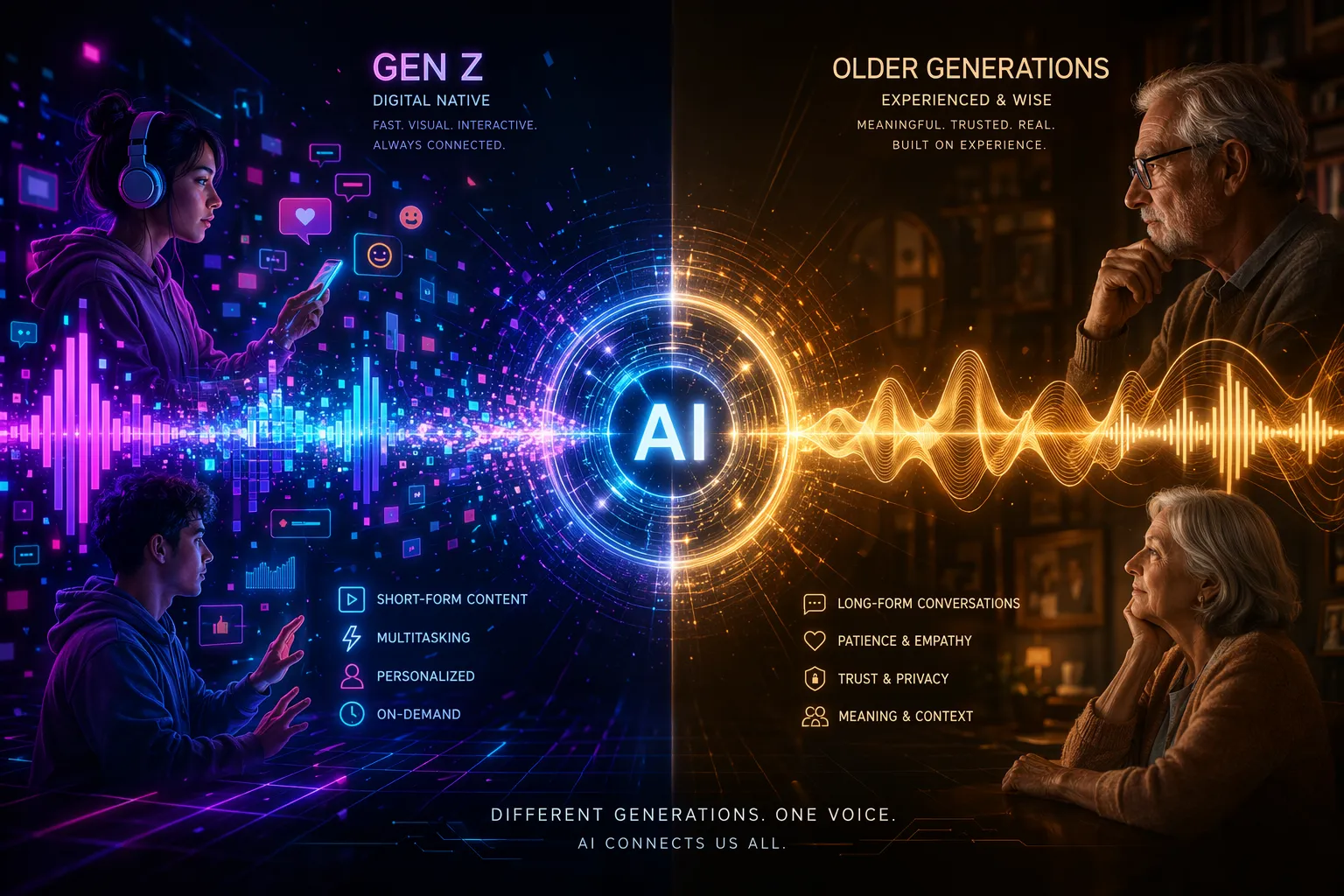
TL;DR: Different generations have different expectations, but all equally despise waiting and pressing buttons ("press 1"). Gen Z and Millennials value instant speed, while for Boomers, the most important thing is a simple, natural phone conversation without complex menus. The POSKAI AI assistant adapts to both needs: it responds to inquiries in under 500 ms and communicates in natural Lithuanian, just like a human. And all this costs businesses from €500/month.
Is AI customer service suitable for all generations?
Business owners, logistics managers, and sales directors often face the same fear before implementing automation solutions: "Our customers are older, they definitely won't want to talk to a robot." This is a natural but completely outdated assumption stemming from traumatic experiences with old communication technologies.
We have all called a telecommunications company, a bank, or a public institution, where for ten minutes we had to listen to a robotic voice: "If you want to know your account balance, press one... If you want to connect to an operator, please wait." Such an experience annoys everyone without exception – from an eighteen-year-old student to an eighty-year-old senior. Even worse, that waiting and button-pressing directly costs businesses money and loyal customers.
However, modern artificial intelligence, such as the POSKAI voice engine, fundamentally changes the rules of the game. We are no longer talking about pressing buttons or a synthetic voice that goes silent for three seconds after your answer because it's "loading" information. We are talking about a natural, fluid conversation in Lithuanian that takes place in real-time. Different generations still have different communication habits, but appropriately adapted AI technology can meet the needs of each of them, leaving no room for frustration.
Let's examine how specifically Generation Z (Gen Z), Millennials, Generation X (Gen X), and Baby Boomers react to POSKAI AI calls and what they truly expect from your business.
Gen Z and Millennials: Speed above all else
Younger generations – Gen Z (born after 1997) and most Millennials (born 1981–1996) – grew up with the internet in their pockets. According to Salesforce research, the absolute most important customer service metric for these groups is instant speed.
These consumers have absolutely no patience for waiting on the phone line for more than a few tens of seconds. They would rather send a message or use self-service, but if the problem is complex and requires a call, they expect it to be resolved here and now.
- Intolerance to waiting: A Gen Z user will, without hesitation, prefer to talk to POSKAI AI, which will solve their problem (e.g., change a delivery address) in 30 seconds, rather than wait 10 minutes for background music until a live operator connects.
- Digital trust: These generations use various AI tools daily. They have no preconceived notions against technology. On the contrary – a business that uses modern solutions and does not have long waiting queues appears innovative and respectful of the client's time in their eyes.
- Concreteness and pragmatism: They don't want long introductions, artificial pleasantries, or additional offers (upsells) when they need a direct answer. They ask "Where is my shipment?" and expect to hear the address and time, not a story about the company's values.
"If a customer has to wait 15 minutes to find out something basic, you've already lost them. In today's business environment, speed is no longer a competitive advantage; it's a minimum hygiene requirement."
The POSKAI AI assistant is ideal for this group. Since the response speed is less than 500 milliseconds, the conversation happens instantly. There are no pauses, no "please wait while the system loads." The user calls, asks "Can I change my appointment to Thursday?" and gets an instant answer and confirmation because the POSKAI AI is directly connected to your calendar. Read more about how POSKAI AI transforms general customer service.
Gen X: The seekers of efficiency
Generation X (born 1965–1980) stands on the threshold between the analog and digital worlds. They vividly remember times without the internet, but today they are active users of technology and e-commerce. Their approach to customer service is extremely pragmatic: "I don't care who solves my problem – a human or a machine, it's important that it's solved efficiently and I don't have to repeat the same thing twice."
As noted by Forbes business analysts, this generation is extremely busy. These are people at the peak of their careers, leading companies, often balancing work and family (caring for both children and aging parents). Their time is their most valuable resource.
- Results-oriented: If the POSKAI AI assistant quickly takes their order or reschedules an appointment without errors – they will be very satisfied and become loyal customers.
- Skeptical of flaws: If the technology freezes, misunderstands a command, delays an answer by 3 seconds, or forces them to repeat the same thing multiple times, Gen X's tolerance threshold will be crossed very quickly. They will prefer to press "0" or ask to be connected to a human.
- Values transparency: It is important for this generation to know who they are talking to. If the conversation starts transparently: "Hello, I am the smart POSKAI AI assistant, how can I help you?", they will appreciate this openness and adapt to the system by asking clear questions.
That's why on the POSKAI platform, we always ensure that calls meet the highest standards of transparency. Furthermore, the POSKAI AI can process complex logical chains, so even if a Gen X representative (for example, a B2B business client) asks a complex question about invoice details or B2B contract terms, the POSKAI AI can integrate with your CRM in real-time and provide an accurate answer on the spot.
Baby Boomers: The need for human connection and simplicity
This is the generation (born 1946–1964) that businesses worry about the most when it comes to implementing AI in customer service. There is a prevailing myth that older people reject technology and only want to communicate with a live person. This is a distorted truth. In reality, they reject complex and frustrating technologies that require instructions to use.
For this generation, the telephone has been the primary and most reliable means of communicating with businesses throughout their lives. According to Harvard Business Review insights on customer behavior, personal contact by phone is associated with trust, reliability, and quality for them.
- Need for conversation: Boomers don't like to formulate inquiries like search engines. They prefer to tell their problem in natural sentences with a backstory, rather than trying to fit it into narrow categories.
- Hatred of button menus: Old IVR (Interactive Voice Response) systems are a real nightmare for this generation. Trying to remember whether to press 3 or 4, and getting lost in deep menu levels, causes immense stress and often ends with a hung-up phone.
- Reaction to quality: If the POSKAI AI voice sounds unnatural, choppy, like an old robot from a sci-fi movie, they will immediately feel distrust. They will think the company is trying to get rid of them.
This is where the greatest strength of the POSKAI voice engine is revealed and why we differ from others.
Imagine a 75-year-old senior calling a polyclinic or a dental office. Instead of hearing button menus or waiting 20 minutes in line, they hear a pleasant, natural Lithuanian voice: "Hello, this is the clinic's POSKAI AI assistant. How can I help you today?"
The senior doesn't answer with a single word. They say: "You know, I have an appointment with a cardiologist on Wednesday for tests, but my daughter won't be able to bring me in the morning. Can it be moved to Friday, maybe closer to noon?"
A traditional chatbot would get lost in this sentence. The POSKAI AI fully understands this long, natural sentence, distinguishing the essence from the backstory. It checks the calendar and responds: "I understand. On Friday, at 11:30 AM, the doctor has free time. Would this time suit you?"
No stress. No buttons. No rushing. Just a simple, human conversation. For older people, this way of communicating is much more acceptable than browsing websites or working with mobile applications that they don't even want to download. They see no difference between a very good POSKAI AI assistant and an extremely helpful reception employee – both listen, both understand, both solve their problem.
Why traditional solutions no longer work?
Many companies in Lithuania, trying to automate processes, make a big mistake: they try to implement cheap "custom" solutions, foreign platforms, or stick to outdated call centers. This leads to catastrophic results for all generations:
- Disadvantages of foreign platforms (e.g., Synthflow, Bland AI): Their response time (latency) often reaches 2–5 seconds. This long pause creates significant friction. Gen Z thinks the connection has been lost, and Boomers start repeating their question a second time, thinking they weren't heard. Moreover, the accent of these foreign systems and artificially "translated" Lithuanian immediately alienates the local user.
- Data security risks: Older generations are extremely sensitive to the security of their personal data. American platforms send data to US servers, which is a direct and gross violation of GDPR. POSKAI is a platform with 100% EU data residency, isolated environment, and end-to-end encryption for each client. Your data never intertwines with others. Learn more about POSKAI security and GDPR compliance.
- Minute-based pricing – a trap for businesses: This is another hook of cheap platforms. Foreign providers charge per minute – even if the customer is silent, thinking what to answer, or if your POSKAI AI is talking to an answering machine. You simply pay for silence. POSKAI uses transparent monthly pricing.
Let's compare POSKAI with other alternatives. You will see why we are the technological leader in the Lithuanian market and why our solution costs less, despite significantly higher quality. We recommend reading our detailed comparison of POSKAI AI assistants with competitors.
Comparison: How different solutions meet generational expectations
Below is a table showing how different solutions cope with daily customer service and calls when evaluated against the expectations of different generations.
| Solution | Price/month | Response Speed (Gen Z) | Language Naturalness (Boomers) | Security (GDPR and Isolation) |
|---|---|---|---|---|
| POSKAI AI | from €500 | < 500 ms (Instant) | ✅ Native Lithuanian | ✅ 100% EU, per-client isolated |
| Human (SDR) | €2100-3500 | Good, but queue waiting | ✅ Native | ✅ High |
| American AI | ~€1500 + hidden | 2-5 seconds (annoying) | ❌ Poor, broken language | ❌ US servers, huge risk |
| Traditional IVR | ~€100 | No conversation, buttons | ❌ Robotic voice | ✅ Depends on server |
As you can see, hiring a human (SDR or customer service specialist) is great for naturalness, but it costs from €2100 to €3500 per month, plus taxes, workspace, holidays, and sick leave. Meanwhile, the POSKAI AI assistant, with prices starting from €500/month, provides the same language naturalness but adds unlimited scalability – POSKAI can talk to 500 customers simultaneously, completely eliminating the waiting queue that all generations dislike so much.
POSKAI AI versatility: One platform for any generation and market
How do we ensure that our technology suits all clients and business niches? The answer lies in our engineering and infrastructure architecture, which is specifically adapted for B2B and B2C sectors:
- Per-client isolation: Unlike shared SaaS platforms where all clients "hang" on one base, each POSKAI client receives isolated infrastructure. An incident with one client will never affect another.
- Real-time multilingualism: If a young Gen Z representative from abroad or a logistics partner from Germany calls and starts speaking German, the POSKAI AI automatically recognizes the language and switches to German that same second. No "Press 2 for English."
- Contextual understanding: The POSKAI AI not only listens to words; it understands intent and context. If an older person tells a long backstory, the POSKAI AI assistant politely listens instead of rudely interrupting.
This is especially relevant in the logistics and transport sector, where dispatchers have to call 30 drivers every morning to find out where the cargo is. The POSKAI AI can automatically call all drivers and collect statuses in 5 minutes. Read more about real application examples on our logistics and transport solutions page.
Stop guessing – let technology adapt
Businesses no longer need to choose between innovation that will appeal to the young and traditions that will retain older customers. Properly configured, a natural language-speaking POSKAI AI effectively bridges this gap.
Gen Z will appreciate that they don't have to wait a second and their matter is resolved at night or on the weekend. The older generation will be happy that they can finally just state their problem over the phone in their native language, instead of pressing dozens of buttons or trying to navigate a complex mobile application that they don't even want to download.
When you use a platform that manages the entire telephone communication chain, you not only drastically save costs (from €500/month instead of thousands) but also improve the customer experience for everyone – from student to senior. Your team stops being an expensive phone switchboard and starts doing work that actually brings in money and grows your business.
Frequently Asked Questions
Do older people understand that they are talking to a POSKAI AI assistant?
Yes, POSKAI systems operate strictly according to the EU AI Act's transparency requirements and always politely introduce themselves as smart POSKAI AI assistants at the beginning of the conversation. However, because the conversation takes place in very natural and fluid Lithuanian, users quickly relax and communicate as if with a live human.
What if POSKAI AI doesn't understand a specific client's accent, pronunciation, or long backstory?
The POSKAI voice engine is specially trained for the Lithuanian market. It perfectly understands different dialects, colloquial slang, and informal expressions that foreign platforms simply cannot decipher. If the question exceeds the POSKAI AI's competence or becomes too complex, the call, with the entire conversation context, is smoothly redirected to your company's live manager.
Is POSKAI AI suitable for international calls, for example, in expedition?
Absolutely. The POSKAI AI assistant supports automatic multilingual recognition. A user can start a conversation in Lithuanian, and the POSKAI AI will instantly switch if it hears a response in English, German, Polish, French, Spanish, or Latvian. This is ideal for sales and logistics teams working with international markets.
How much does the POSKAI AI assistant cost for businesses?
POSKAI pricing starts from €500/month. This is an all-inclusive, fixed monthly fee that includes POSKAI AI infrastructure, voice technologies, telephony, and a personalized dashboard for your company. There are no hidden fees or misleading minute-based pricing.
Ready to upgrade your customer service?
Contact the POSKAI team. We will discuss your processes and show you how the POSKAI AI assistant can help your business save thousands of euros every month while maintaining the highest service quality for all generations – without any compromises.
Contact us and get an offer