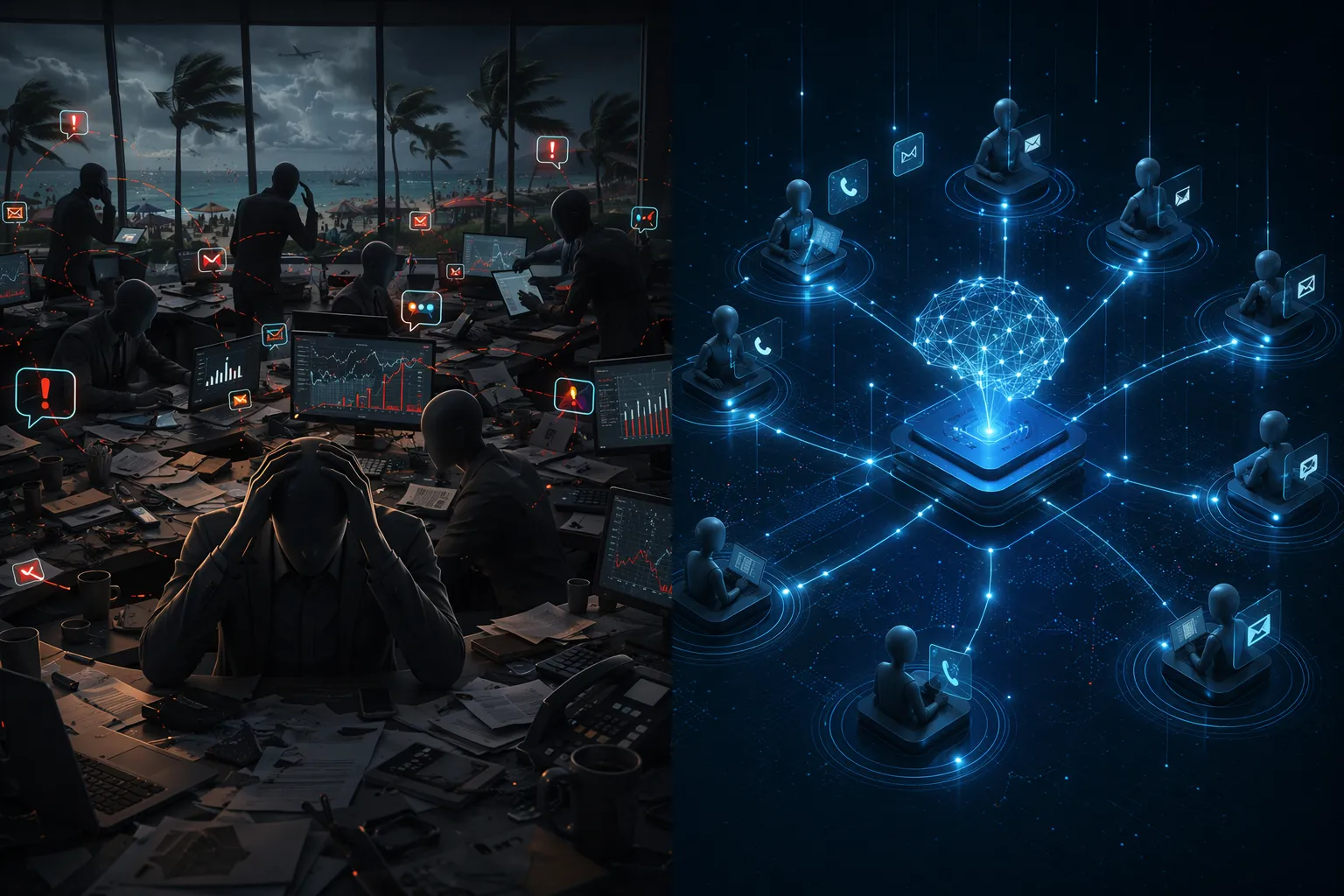
TL;DR: Hiring a seasonal employee in Lithuania, including taxes, costs from €1200-1500/month, not accounting for recruitment, training time, and error costs. Meanwhile, a POSKAI AI assistant costs from €500/month, works 24/7 without holidays, requires no training after implementation, and can handle over 500 calls simultaneously. This is not just a question of cost, but also operational stability.
Why does the search for seasonal employees become a bigger headache every year?
Every spring, thousands of Lithuanian companies – from logistics centers to hotels, tourism agencies, and retail chains – face the same challenge. A frantic preparation for the summer season begins, an integral part of which is the mass search for temporary staff. CV portals are full of job advertisements, HR departments are drowning in interviews, and managers are bracing for the annual chaos.
However, in recent years, the labor market situation has changed dramatically. Finding a motivated, responsible, and communicative person for short-term work has become not only expensive but almost an impossible mission. Young people, traditionally filling these positions, increasingly choose more flexible, less binding ways of earning or seek international opportunities. And those who do agree to work in customer service or sales support for the summer often have no experience and, frankly, little motivation to gain it.
Imagine a typical situation in mid-July. The business is operating at full capacity. Phone lines are buzzing with customer inquiries: "Where is my order?", "Do you have any vacancies?", "I want to cancel my reservation." And your seasonal employee, whom you trained just three weeks ago, doesn't show up for work because, well, it's summer. The phone keeps ringing, orders are lost, customers are angry, and your permanent team, on the verge of burnout, tries to put out fires.
This is the cost you don't see in the job advertisement. The shortage and unreliability of seasonal employees create a chain reaction that directly impacts the company's reputation and revenue. This raises a fundamental question: is it really worth repeating the same mistakes every year when technology offers an alternative that essentially eliminates this human factor? This is precisely why more and more companies are turning to AI customer service and deciding that it's time to change the rules of the game.
How much does a seasonal employee actually cost in Lithuania?
Often, business owners make a crucial mistake when comparing the cost of an employee and technology – they only look at the "net salary." However, the real cost of a seasonal employee is significantly higher, and when it comes to customer communication by phone, hidden costs can be disastrous.
Let's look at the numbers more closely.
- Salary and Taxes: Even if you hire an inexperienced student and pay them only the minimum wage, with all social security (Sodra) and tax office (VMI) contributions, company costs quickly reach €1200–€1400 per month. If you want someone who speaks English or Polish fluently, the price jumps to €1800–€2000/month.
- Workplace Setup: Computer, professional noise-canceling headphones, ergonomic chair. Net jei tai laikina darbo vieta, jai reikalinga įranga, kurios amortizacija ar nuoma kainuoja pinigus.
- Software Licenses: A new user in your CRM system, an IP telephony account, an email inbox, communication tools – these are an additional €50–€100 per month for each temporary employee.
Hidden costs that cost the most:
- Recruitment Time: Job portal fees (from €50 to €200 per advertisement), HR specialist's or department head's time spent reviewing CVs and conducting interviews. These are invisible costs that take time away from growing the business.
- Cost of Errors: A seasonal employee does not know your product as well as the permanent team. They might incorrectly register an order, forget to enter an important detail into the system, or accidentally promise a customer something you cannot fulfill. Correcting these errors costs your best employees' time and often – customer loyalty.
- Missed Calls: A person can only talk to one client at a time. What do the other 5 clients calling during peak hours do? They wait, listen to music, and usually hang up to call competitors. The latest Lithuanian labor market research (target="_blank") confirms that employee turnover directly reduces customer service efficiency.
Compare this to the POSKAI platform. POSKAI pricing starts from €500/month. With no hidden fees for workplace setup, no lengthy recruitment processes, and most importantly, no limits on how many calls can be handled simultaneously. When 50 customers suddenly call you at once – POSKAI answers all of them in less than 500 milliseconds.
Training and adaptation: time you simply don't have in summer
One of the biggest illusions of seasonal work is the belief that "we will hire someone, and they will immediately start bringing value." The reality is much harsher. Any, even the simplest, customer service or call handling job requires specific knowledge.
For an employee to independently answer customer questions, they need to learn your systems, understand product specifications, know company procedures, and learn the communication tone. This typically takes 2 to 4 weeks of intensive training, led by your experienced employees. Yes, the same employees who are currently dealing with summer peak orders.
What happens in practice?
- You hire someone at the beginning of June.
- For two weeks, your best salesperson or customer service manager does not do their direct job because they are sitting next to a newcomer explaining how the system works.
- In July, the newcomer finally starts working independently but makes many mistakes that still need to be corrected by experienced colleagues.
- At the end of August, when the newcomer finally becomes truly useful and independent... their studies begin, and they leave the job.
This is a vicious circle where a business burns thousands of euros on training, receiving only a month or a month and a half of mediocre quality work in return.
How does POSKAI AI solve this problem? No onboarding or training time. When the POSKAI voice engine is integrated with your knowledge base, it learns everything instantly. You don't need to allocate two weeks for training – the AI system immediately knows all your product specifications, return policies, pricing, and FAQs.
Moreover, unlike a human, POSKAI never forgets information, doesn't confuse facts, and always uses the same polite, professional tone. This is especially relevant when it comes to outbound calls for B2B sales, where every intonation error can cost a potential client.
Reliability: Illness, holidays, and "ghosting" vs. 24/7 operation
If you ask any manager working with seasonal employees what their biggest stress is, the answer would be one: unreliability. Seasonal employees very often do not have a strong sense of loyalty to the company because they know they will not be working here in the autumn.
This means you constantly face the risk of:
- Sudden sick leave on Monday mornings (especially in summer).
- Requests to leave early because "the weather is nice by the lake."
- And the worst-case scenario – "ghosting," when an employee simply doesn't show up for work without any warning or valid reason.
Each such case means unanswered calls, unconfirmed appointments, and lost money. If your business depends on every customer being called during the summer (e.g., to confirm a visit or remind about an invoice), human unreliability becomes a critical business risk.
Meanwhile, POSKAI AI works 24 hours a day, 7 days a week, 365 days a year. It doesn't get sick, doesn't go on vacation, doesn't need coffee breaks, and is never late. If a foreign client calls you at 11:00 PM on a Friday evening wanting to make a hotel reservation, POSKAI will politely answer and arrange everything in the client's native language. A human employee would most likely not even be at work at such a time.
Multilingualism: A challenge for humans, a standard for AI
The summer season often means an increased flow of foreign clients – tourists, foreign partners, international logistics drivers. Finding a temporary employee in Lithuania who speaks Lithuanian, English, German, and, for example, Polish fluently, without an accent, and professionally, is practically impossible. Even if you find one, their salary expectations will certainly not be "seasonal."
The most common scenario: companies hire someone who speaks only Lithuanian and mediocre English. When a client from Germany or Latvia calls, misunderstandings begin, information is lost, and ultimately – sales are lost.
POSKAI technology solves this problem by completely eliminating the language barrier. POSKAI AI automatically detects the caller's language and switches it in real-time. A Lithuanian calls – the AI speaks in natural Lithuanian, without any accent. A minute later, a driver from Poland calls – the same POSKAI AI seamlessly switches to Polish and continues the conversation.
This gives your business the image of an international, professional player, without requiring thousands of investments in multilingual call centers. Read more about AI cold calling in Lithuanian and other languages.
AI Assistant vs. Temporary Staff: Direct Comparison
To better understand the differences, let's compare the capabilities and costs of both solutions in key aspects.
| Criterion | POSKAI AI Assistant | Seasonal Employee |
|---|---|---|
| Cost (from) | from €500/month | ~€1400/month (with taxes) |
| Availability | 24/7/365 without breaks | 8 hours/day, only on weekdays |
| Training Duration | 0 days (learns instantly) | 2-4 weeks |
| Call Capacity | 500+ simultaneously | 1 call at a time |
| Languages | LT, EN, DE, PL, LV, FR, ES (auto-detection) | Usually only 1-2 languages |
| Reliability | 100% (doesn't get sick, no holidays) | Depends on human factor |
| Data Security | Full EU isolation, encryption | Risk due to human error |
As seen from the table, by choosing seasonal staff, you pay at least 3-4 times more for a solution that is slower, more limited, and requires constant supervision from your team.
Data Security: Why POSKAI, not foreign platforms?
Often, businesses, understanding the benefits of automation, try to find the cheapest platforms on the US market (e.g., Synthflow, Bland AI, or Retell). However, they forget that by transferring their clients' phone numbers and call recordings to American systems, they violate GDPR requirements. These systems store all client data on shared servers, so a security breach at one company can expose your client data.
POSKAI operates on a completely different principle. We understand that business data is sacred. Therefore, every POSKAI client receives:
- Per-client isolation: Your data NEVER intersects with other clients' data.
- 100% EU data residency: All your call recordings and transcripts remain within the European Union, adhering to the highest standards.
- Protection against "prompt injection": Your POSKAI AI assistant cannot be "hacked" or forced to reveal commercial secrets to outsiders.
You can feel secure knowing that EU requirements (including the new EU AI Act) are implemented at an architectural level. You can find more about the differences from foreign and local platforms and our distinctiveness in the market in a detailed comparison with AInora.
How POSKAI changes the rules of seasonal business? (Real Scenarios)
How does this technology work in practice? Here are some examples of how Lithuanian companies are already using the POSKAI platform to solve summer challenges.
1. Logistics and transport during summer peak:
Instead of hiring additional dispatchers to call 30 drivers every morning, companies delegate this to POSKAI. The AI calls all drivers in Polish, Russian, or English in 5 minutes simultaneously and collects statuses. Your logistics manager opens a dedicated "Custom Dashboard" page and sees the entire summary. If a shipment is delayed, POSKAI automatically informs the client. View our detailed logistics use case.
2. Tourism and hotels:
During the summer season, reception doesn't have time to answer questions like "Until what time is breakfast?" or "Do you have any rooms available this weekend?". POSKAI takes over all these repetitive questions. If a client wants specific information that the system doesn't know, the AI intelligently transfers the call to the administrator. You don't lose clients even at night, as the system works 24/7 and answers in all major tourist languages.
3. Debt and payment reminders (B2B):
During the summer, responsible company personnel are on vacation, and invoice payments are delayed. Instead of your finance department or temporary employees calling companies, POSKAI politely but persistently calls debtors and reminds them of overdue payments. The AI notes all promises ("we will pay on Thursday") and updates your database.
4. Rental and service sector:
"Do you have a free trailer?" or "Can I cancel my hairdresser's appointment?". POSKAI automatically synchronizes with your calendar, registers appointments, and sends confirmation emails or SMS messages after each call. This allows your specialists to focus on their work, rather than holding the phone.
Conclusion: The season can be productive, not stressful
Hiring temporary staff for short-term, routine call functions is increasingly becoming a thing of the past. It's too expensive, requires too much management, and brings too little stable value.
By choosing POSKAI, you not only reduce operational costs but also invest in infrastructure that will never let you down, never take a vacation, and ensure an impeccable customer service experience at all times. Your team will finally be able to stop acting as a phone switchboard and focus on what truly grows your business and creates value for customers.
---
Frequently Asked Questions
How much does a POSKAI AI assistant cost compared to an employee?
POSKAI pricing starts from €500/month. This is a fully managed, fixed price, with no hidden "per-minute" or telephony charges. In comparison, the minimum salary for a seasonal employee, including all social security and tax office contributions, costs a company over €1200-€1400 per month.
Will I need special IT knowledge to run a POSKAI assistant?
No, absolutely no IT knowledge is required. POSKAI is a fully managed service. Our team of engineers configures everything, prepares communication scripts, and integrates the system for you. You simply see the results in your personal, secure client portal (dashboard).
Can AI speak naturally in Lithuanian and not sound like a robot?
Yes, the POSKAI AI assistant speaks in native, completely natural Lithuanian. This is not just text translated into voice – our system has a specially adapted voice engine that maintains intonation, reacts to pauses, and creates a human-like conversation experience, without delays in answering.
Is it safe to use AI with our clients' phone numbers?
This is our priority. POSKAI ensures 100% EU data residency and GDPR compliance at an architectural level. A strictly isolated infrastructure is created for each client – your data never intersects with any other company. All traffic is encrypted (End-to-End).
How quickly can we start using POSKAI before the summer season?
Unlike the 2-4 weeks required for employee recruitment and training, the POSKAI platform can be implemented and fully adapted to your specific needs in just a few days. You will be able to welcome the season without any stress due to staff shortages.
Ready to automate your seasonal calls?
Stop burning money and time searching for temporary employees for repetitive tasks. Contact the POSKAI team and find out how a POSKAI AI assistant can stabilize your processes.
Get a proposal