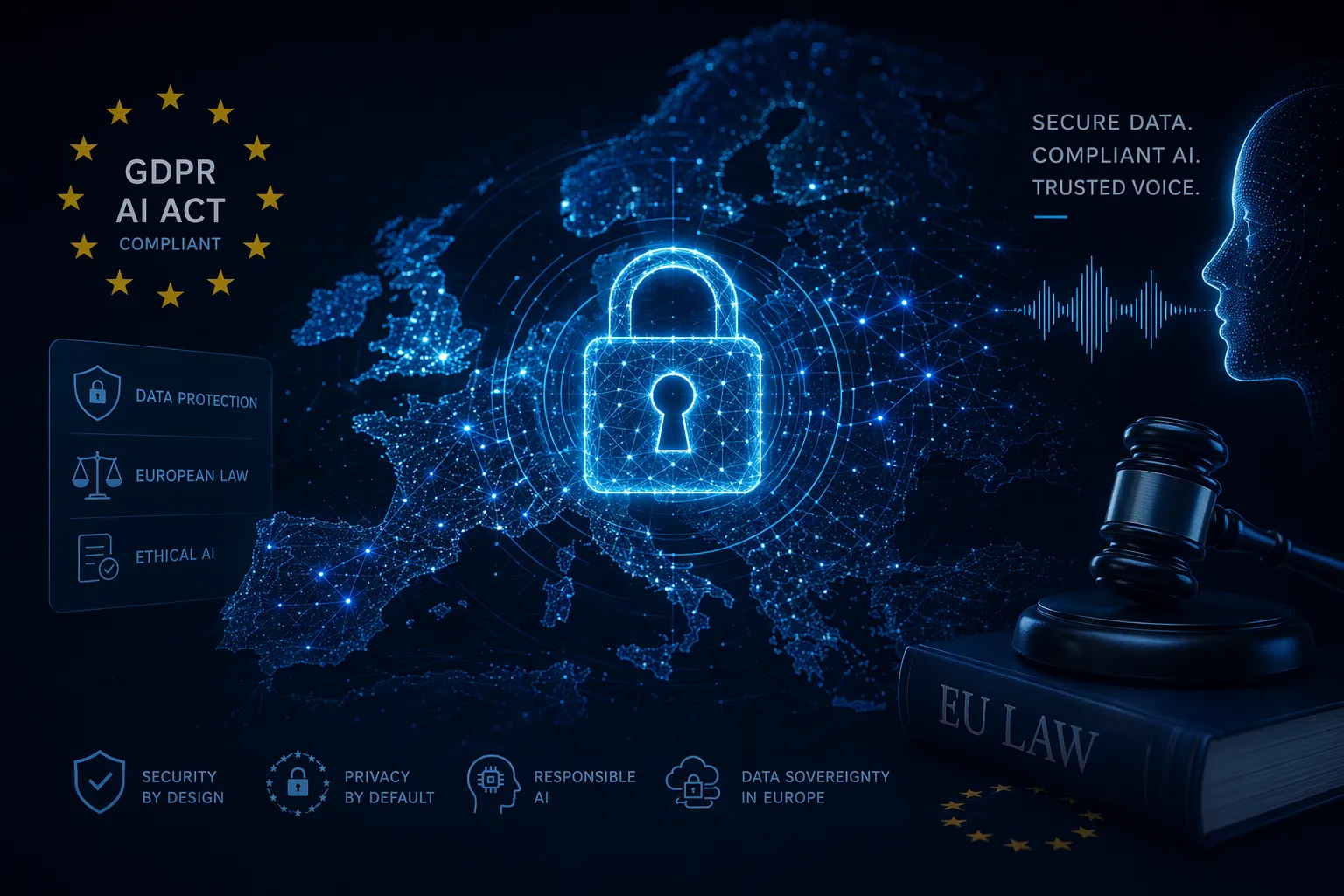
TL;DR: Most foreign AI voice platforms send your clients' personal data to US servers, directly violating GDPR requirements, and all legal responsibility falls on your business. These violations can result in fines of up to €20 million. Unlike shared SaaS solutions, the POSKAI AI platform ensures 100% data residency within the European Union and an individual, isolated infrastructure for each client.
Why have GDPR and AI calls suddenly become the biggest business risk?
Lithuanian companies are increasingly discovering the benefits of artificial intelligence. From B2B sales automation to daily customer service, technology is changing how we communicate with clients. However, this wave of innovation also brings immense legal risks that most business leaders don't even consider.
When your employee talks to a client on the phone, you have clear procedures. You know where the call recording is stored, who has access to the data, and how long it is kept. But when a cheap AI assistant, downloaded from the internet or configured by obscure providers, performs the same work, the situation changes drastically.
What truly happens to your client's voice, their phone number, and the content of the conversation?
Often, the answer is alarming. When you use popular foreign platforms or solutions assembled by local "developer-enthusiasts," your clients' personal data instantly leaves the borders of the European Union. It travels through third-party servers, is analyzed by unclear algorithms and is often used to train other AI models. This is not just a technical detail – it is a direct violation of the General Data Protection Regulation (GDPR). And responsibility for it lies not with the platform developer, but with you.
How do popular US platforms violate GDPR requirements?
If you've come across names like Bland, Retell, Vapi, or Synthflow, privalote žinoti vieną kritinį faktą: these platforms are designed for the US market, and for them, European Union data protection standards are merely an obstacle, not a priority.
Here's how a standard US-built AI voice solution works:
- Data leakage to US servers: When your client says their name, surname, or order number, this voice recording is instantly sent to servers located in the US for processing. Under GDPR, the transfer of personal data to third countries without appropriate safeguards is strictly prohibited.
- CLOUD Act threat: The US CLOUD Act obliges US technology companies to provide client data to law enforcement, even if those data are physically stored on European servers. This means your Lithuanian clients' information can become accessible to third parties at any time.
- Terms of Service traps: If you carefully read the agreements of these platforms, you will see a sentence that reads something like this: "We do not assume responsibility for GDPR compliance; you yourselves must ensure that you have the right to send us this data." This means the platform washes its hands, and in case of a fine, the only responsible party will be you.
What is the legal responsibility of a company executive for AI personal data processing?
Many executives mistakenly believe that by purchasing an IT service, all legal responsibility transfers to the provider. In the case of GDPR, this is a fatal error. Your company is the data controller, and the POSKAI AI platform is only the data processor.
As a data controller, you are 100% responsible for what tools you choose and where your clients' data goes. If your chosen AI assistant leaks information or processes it unlawfully, the State Data Protection Inspectorate (VDAI _target="_blank"_) will fine your company.
Key risk factors and consequences:
- Huge fines: GDPR violations can incur fines of up to €20 million or up to 4% of the total annual worldwide turnover, whichever amount is greater.
- Mandatory notification: In the event of a data security breach (for example, if a US platform suffers a cyberattack), you must notify the VDAI within 72 hours and, in many cases, the clients themselves.
- Reputational damage: Imagine having to inform your best B2B clients that their phone numbers, conversation content, and commercial secrets have leaked because you decided to save a few dozen euros by purchasing an unclear AI solution. This is a blow from which rebuilding business relationships is incredibly difficult.
Is your client data used to train other models?
One of the biggest, but least discussed, problems in the AI market is the Shared SaaS (shared usage) infrastructure model. Most providers use one common database and one common system for all their clients.
What does this mean in practice?
If a platform has 500 clients, your company's data, call recordings, and client contact lists reside in the same system, alongside the data of 499 other companies. If even one of those 499 clients experiences a security vulnerability (for example, due to a weak password or hacking), your data is also directly threatened.
Even worse, many cheap AI platforms exploit your company's conversations to train their basic AI models. Your best sales scripts, your clients' objections, and your commercial information can become material from which your competitors' bots will learn. Secure AI customer service is impossible without complete data isolation.
How POSKAI addresses GDPR challenges in the Lithuanian market?
Understanding that security is not an object of compromise for business clients, we designed the POSKAI platform based on completely different architectural principles. POSKAI is not an ordinary SaaS platform – it is an enterprise-level infrastructure adapted for the European Union market and the strictest data protection requirements.
Here's why POSKAI AI is the only logical choice for Lithuanian companies concerned about security:
- Per-client isolation: We do not use shared databases. Each POSKAI client receives an individual, separate infrastructure. Your data never intertwines with the data of other companies. Even if an incident theoretically occurs in another client's system, your information remains completely secure. This is a unique architectural solution that almost no other market player offers.
- 100% EU data residency: All POSKAI servers and data processing centers are physically located in the European Union. No personal data, call audio recordings, or transcripts ever leave the EU territory. We do not violate GDPR because we are designed according to GDPR.
- End-to-End encryption: Every call, every byte of audio, and every text transcript is encrypted. Only you have access to this data through your dedicated POSKAI management dashboard.
- Prompt Injection Protection: Our POSKAI voice engine has integrated protection systems that prevent malicious actors from tricking the POSKAI AI assistant into extracting confidential information.
- Clear legal responsibility: Unlike foreign platforms that hide behind complex terms, POSKAI takes responsibility as your data processor. We sign official data processing agreements that comply with all Lithuanian and EU laws.
"Artificial intelligence in customer service is the future, but if that future is built on insecure infrastructure foundations, it will bring more legal problems than financial benefits. Security should not be an optional extra – it must be the core of the platform."
How much does a secure POSKAI AI assistant cost vs. risky alternatives?
Choosing the wrong solution often turns an initially low price into huge hidden costs. Although US platforms often tempt with seemingly low per-minute rates, when you add all hidden fees, integration costs, and invaluable legal risk, the picture becomes completely different.
POSKAI offers transparent, fixed pricing that allows you to accurately plan your budget without any surprises. Here's what the real market situation looks like:
| Solution | Price per month | Security and GDPR | Hidden fees |
|---|---|---|---|
| POSKAI AI | from €500/month | ✅ 100% EU, Isolated | None (all-inclusive) |
| US Platforms (Bland, Retell) | €500-€2000 | ❌ US servers, high risk | Telephony, LLM costs per minute |
| Call Center (human) | €1500-€4000 | ⚠️ Depends on agency | Staff turnover, holidays, sick leave |
| Local "Custom" bots | ~€5000 (one-time) | ❌ No support or updates | System maintenance after 6 months |
As you can see, the POSKAI solution is not only the safest but also the most financially logical choice for businesses looking to automate calls, whether it's for the logistics and transport sector or medical clinic appointment management.
EU Artificial Intelligence Act (AI Act): Are you ready for it?
In addition to the already active GDPR, the European Union's Artificial Intelligence Act (EU AI Act _target="_blank"_) is coming into force. This is the world's first comprehensive legal regulation of artificial intelligence, which will directly affect every business using AI for customer communication.
One of the main requirements of this act is transparency. Your clients must be clearly informed that they are speaking with artificial intelligence, not a living person. Furthermore, AI systems must be audited, documented, and comply with strict risk management standards.
Using "black boxes" from abroad, you will not be able to prove how the algorithm works and whether it meets the transparency requirements set by the EU. The POSKAI AI technology architecture is designed to meet not only current GDPR but also future EU AI Act requirements by default (compliance by design). You will not need to hire expensive lawyers or IT auditors – the POSKAI platform ensures that your business operates legally.
Conclusion: Choose infrastructure you can trust
In the world of technology, cheap and fast often means insecure. By entrusting your client data to third parties whose servers are located on another continent, you risk your business reputation and financial stability.
POSKAI is not just a tool for making calls. It is a robust, secure, and fully managed business communication infrastructure where your data belongs only to you. Stop worrying about fines and let the secure POSKAI assistant take over repetitive tasks while your team focuses on business growth.
Read more about how much AI calls actually cost in Lithuania or find out how this technology is applied in different sectors.
Frequently Asked Questions
Do I need to get separate client consent under GDPR when using AI voice assistants?
If the client calls you themselves (inbound call), standard notification about call recording and data processing is sufficient. If you are making cold calls (outbound), the same rules apply as for live managers – you must have a legal basis or prior consent to process personal data for direct marketing purposes.
Why can't foreign platforms ensure GDPR compliance?
Most US platforms use servers and infrastructure located outside the EU. Additionally, they often employ a shared SaaS model where all client data is stored in one place, and they do not meet the strict data isolation requirements dictated by European laws.
How does the POSKAI platform ensure client data security?
POSKAI uses a per-client isolation architecture. A separate, isolated infrastructure is created for each client. All data is physically stored and processed only on servers located in the EU territory, using the most modern encryption standards.
What should I do if my company is already using an insecure US AI platform?
We recommend performing a data security audit as soon as possible and assessing the risks. To avoid potential fines, the best step is to switch to a provider that complies with EU standards. The POSKAI team can help seamlessly migrate your call processes to a secure, isolated infrastructure without operational disruptions.
Protect your business and client data today
Looking for a secure and GDPR-compliant POSKAI AI voice assistant? Contact the POSKAI team and find out how we can automate your communication without any legal risk.
Get an offer