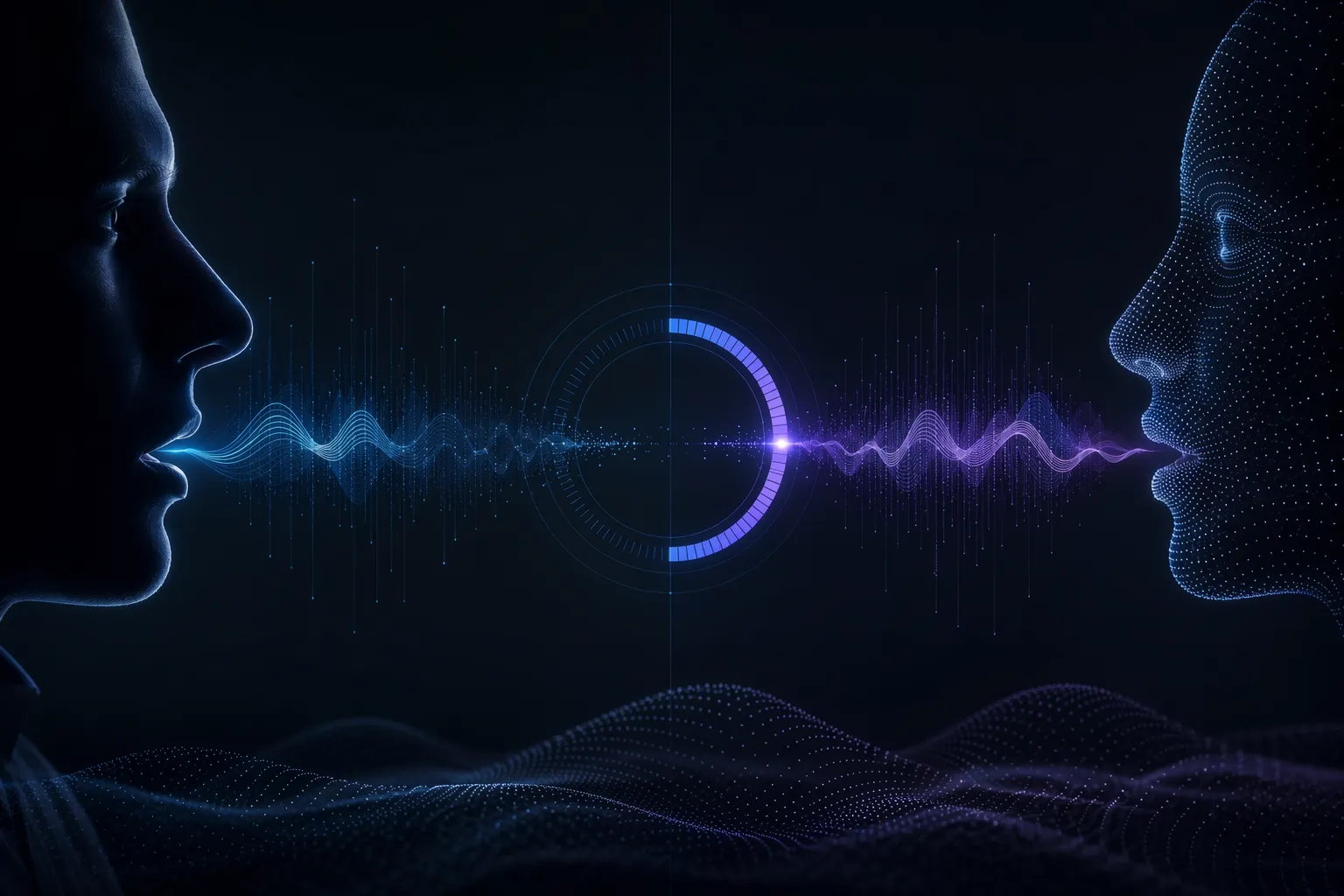
TL;DR: Tradicional AI bots make clients wait 2-5 seconds and continue reciting their script, even when interrupted. POSKAI AI uses advanced real-time audio technology with < 500ms response time — if a client says "wait" or interjects mid-sentence, POSKAI instantly pauses, listens, and naturally continues the conversation. This is the difference between a lost client and a successful sale, starting from €500/month.
Why Do Most AI Calls Sound Like Talking to an Answering Machine?
Imagine a common scenario: a company director, in the middle of a busy workday, receives a call. A voice on the other end starts rattling off a pre-rehearsed offer. After three seconds, the director says: "Excuse me, I can't talk right now, can you call back after lunch?" But the voice on the other end doesn't stop. It continues to talk about the service benefits, completely ignoring the fact that the caller is trying to interrupt. After another two seconds, the click of a hung-up phone is heard.
This is a daily occurrence with old-generation, traditional text-to-speech systems. Business owners, seeking to automate sales or customer service, are often tempted by cheap offers from foreign startups, unaware of a fundamental technological barrier. Traditional bots operate on a chain principle: they listen until the person completely stops speaking, then convert all audio to text, then generate a text response, and only then convert that text back into speech. This process takes 2 to 5 seconds.
In human communication, a 5-second pause is an eternity. Even worse — such systems completely lack what engineers call natural "Voice Activity Detection" (VAD), or voice activity recognition. When a bot starts speaking, it's as if it plugs its ears. It doesn't care if the client is coughing, if a dog is barking in the background, or if the client is trying to raise a critical objection. The bot simply reads its generated script to the end.
Such an experience not only fails to create value. It actively damages your company's reputation and wastes your potential client base (leads), for which you have paid dearly. Your clients don't have time to listen to monologues.
What is VAD, and Why Do Milliseconds Determine a Sale?
Voice Activity Detection (VAD) is essentially a technology's ability to understand when a person is speaking and when there is just background noise, and, most importantly, the ability to react to human interruption in real-time. Human conversations are rarely perfectly linear. We interrupt each other, we say "mhm," "yes," "I understand" while the other person is speaking, we interject to clarify a detail.
If the solution you are using cannot process these natural micro-moments of human speech, the conversation is doomed to fail.
POSKAI AI was developed with precisely this problem in mind. We abandoned the traditional and slow technological chain. The POSKAI voice engine operates entirely differently — it is a real-time audio technology that constantly listens and analyzes the conversation in real-time. Our system's response speed is less than 500 milliseconds (< 0.5 seconds). This is human reaction speed.
When a POSKAI AI assistant presents your service, and the client interjects with: "What about the price?", POSKAI falls silent within milliseconds. The assistant does not finish its previous sentence; it does not argue with the client for airtime. It hears the question, instantly adapts, and answers the client's question directly. This is precisely what creates the illusion (which quickly becomes a reality for your client) that they are speaking with a professional, live sales manager, not an answering machine.
If you want to learn more about how this looks in practice, you can read our detailed comparison with AInora, where we analyze the differences between traditional chatbots and true voice AI in detail.
How Do Traditional Bots Respond to Interruptions? (Traps for Business)
Many business representatives who have tried cheap American tools or local amateur solutions encounter several typical call failure scenarios:
- The "Mhm" Problem: A client, listening attentively, naturally says "yes," "mhm," "I understand." A traditional bot interprets these sounds as full answers. The bot stops speaking, waits 3 seconds, realizes nothing else is coming, and then tries to figure out what to say to "mhm." The result — a completely lost conversation context and an awkward silence.
- Background Noise Error: An ambulance drives by on the street, or someone in the logistics manager's office laughs loudly. A poor VAD system registers this as client speech and interrupts its own presentation.
- The "Train" Effect: As mentioned earlier, if a client has an urgent question, a traditional bot doesn't stop. It continues like a train until the end of its text block. The client gets annoyed, feels unheard, and hangs up.
These technical glitches may seem like minor details to engineers, but for businesses, they represent direct losses. Every hung-up call is a potentially lost contract worth €10,000 or a loyal client lost forever.
POSKAI AI's Ability to Pause and Adapt
POSKAI technology is not just "translated" into Lithuanian. It was created to understand the natural specifics of our language, intonations, and conversation dynamics.
When POSKAI calls a potential client about a new logistics service, the AI assistant behaves exactly like your best sales representative:
- Active Listening: POSKAI AI constantly analyzes the audio stream. It distinguishes a client's "yes, I'm listening" from a dog barking in the background.
- Instant Pause: If the client interjects in the middle of the assistant's sentence, POSKAI cuts off its speech in less than half a second.
- Context Retention: After an interruption, POSKAI doesn't get lost. If the client says, "I'm already using competitor services," the assistant instantly changes the direction of its script and moves to an objection handling strategy, without trying to finish the previous, no longer relevant thought.
It is this flexibility that allows the POSKAI system to maintain complex, in-depth business conversations lasting 15, 20, or even 30 minutes. Most competitor systems "break down" after 3 minutes because they cannot manage the asymmetry of the conversation.
Read more about why it's important to have a system adapted to the local market in our article on AI calls in Lithuanian.
Data and Comparison: What Really Happens During a Call
To better understand the technological gap, let's look at specific parameters that determine call success.
| Parameter | POSKAI AI | Traditional "Custom" Bots | Foreign Platforms (SaaS) |
|---|---|---|---|
| :--- | :--- | :--- | :--- |
| Response Time | < 500 ms | 2,000 - 4,000 ms | 1,500 - 3,000 ms |
| Reaction to Interruption | Stops instantly, adapts | Ignores, continues speaking | Stops, but loses context |
| Background Noise Filter | Advanced (distinguishes speech from noise) | Poor (reacts to everything) | Average |
| Price (monthly) | from €500 (all-inclusive) | €5,000 - €15,000 (one-time) | ~€1,000 + hidden fees |
| Data Security | 100% EU residency, isolation | Unclear, no guarantees | US servers (GDPR risk) |
Real-World Examples: When the Client Takes Control
Theory is one thing, but technology's value is best revealed in real B2B situations. Here are three scenarios where traditional bots fail, and POSKAI AI creates added value.
Situation 1: The Rushed Logistics Coordinator
In logistics companies, time is measured in minutes. When your system calls a driver or coordinator to check cargo status, the caller is usually on the road, at a terminal, or loading goods.
- Traditional Bot: "Good day, I'm calling from company X, I wanted to ask what the status of cargo number Y is and whether..."
- Client Interrupts: "The cargo is already there, everything is fine, goodbye."
- Traditional Bot (doesn't stop): "...are you planning to arrive on time according to the scheduled timetable?"
- Result: The coordinator has already hung up. Status is unclear, the system logs an error.
- With POSKAI AI: When the client says "The cargo is already there," POSKAI goes silent the same millisecond, logs the answer into the system, and politely responds: "Understood, thank you. Have a good day." Everything takes 5 seconds, your dashboard updates the status.
Situation 2: B2B Cold Calling
In sales, client interruption is often not a hindrance, but a buying signal or an important objection that needs immediate addressing.
- Client Interrupts Presentation: "Wait, wait. What about integration with our existing CRM?"
- With POSKAI AI: The assistant immediately cuts off the general value proposition presentation and moves to a specific answer: "Yes, we can fully integrate with your CRM system. Do you use Salesforce or another platform?" This shows that the client is heard and valued.
Situation 3: Customer Service and Elderly People
Clients speak at different paces. Elderly people or those who need time to think make longer pauses between words.
- Client: "I need to register with the doctor... [3-second pause, looking for calendar]... for Tuesday."
- Traditional Bot: Hearing the pause, the bot decides the client has finished and starts suggesting times before the client says "for Tuesday." Chaos ensues.
- With POSKAI AI: POSKAI can distinguish a thinking pause from the end of a sentence, adapting to the speaker's pace and allowing the person to naturally complete their thought.
How Much Does a Poor Call Experience Cost Your Business?
Business leaders often make the mistake of evaluating AI solutions solely by their initial price. An American platform promising calls for cents per minute might seem attractive on paper. However, the true cost lies in lost clients.
Every time your bot interrupts a client, ignores a client's question, or creates an unpleasant, robotic experience — you don't just lose one call. You shape your brand image. In the B2B sector, where the Lifetime Value (LTV) of a single client can reach tens or hundreds of thousands of euros, saving on technology quality is simply irresponsible.
The POSKAI infrastructure is built for companies that understand the value of communication. Our clients receive an isolated, 100% GDPR-compliant (EU data protection requirements) environment, a personalized dashboard, and, most importantly, the most advanced voice technology in Lithuania. And it all starts from €500/month. This is less than the taxes for one average employee, yet you get an assistant that never gets sick, can handle 500+ calls simultaneously, and communicates with your clients as politely as your best team member.
We don't replace your employees. We remove the technological "bottleneck" that prevents your business from growing, by taking over all repetitive phone work.
Frequently Asked Questions
Why can't other AI bots react quickly to interruptions?
Most traditional solutions use several separate systems: one system converts audio to text, another formulates a response, and a third converts text back to audio. This process naturally creates a 2-5 second delay. POSKAI AI uses a real-time audio engine that processes information without intermediate text translation steps, resulting in a response time of less than 500 milliseconds.
Does POSKAI understand when background noise is not actual speech?
Yes. The POSKAI voice engine is trained to distinguish human speech from background sounds such as passing cars, office chatter, or even a client's cough. The assistant will not interrupt its speech due to unrelated sounds but will instantly pause if the client begins to formulate a question.
How much does a POSKAI AI assistant cost for a business?
The POSKAI platform starts from €500/month. This is a fully managed service that includes infrastructure, dedicated encryption, call analytics in your personal dashboard, and the AI assistant itself. Unlike foreign platforms, we do not have hidden fees for phone lines or minutes during which the client is silent.
Can the POSKAI system be adapted for specific sales scenarios?
Absolutely. Every POSKAI client receives an isolated environment where the AI assistant is trained according to your company's services, tone, and specific sales scripts. The system can react to objections, change the conversation topic according to client needs, and even identify the level of interest of potential clients.
Ready to Elevate Your Communication?
Stop burning your client base with slow and robotic bots. Contact the POSKAI team today and discover how a naturally conversing AI assistant can automate your sales and customer service.
Get an Offer